Posts

Week 7 Reading Part D: Mahabharata

Image
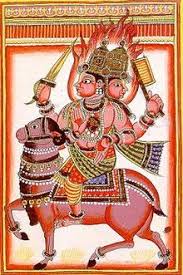
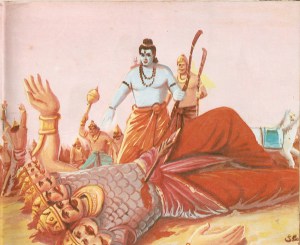
In Part D of the reading, the story that attracted me most was Ashwatthaman's Jewel.   The reason for this was it would give me something in the D&D stories that I have been missing, something crucial to a good D&D campaign.  This missing element is a Big Bad Evil Guy (BBEG), and while Dee-yem is an antagonist, he is not actively evil or against the quintet, and this is the role Ashwatthaman can fill.  I went beyond the reading to find out more about him, because the idea he was almost immortal due to the gem in his head, as well as the continued legends until today, allow for a lot of artistic liberty with the character.  The story itself is somewhat vague on the hunt to retrieve the gem from his head, so that angle is something I would like to bring out more, because it would be an adventure/encouter for the hero's, direct conflict other than running from an overwhelming horde. Ashwatthaman, from  detechter Bibliography: Indian Myth and Legen...
Week 7 Reading Part C: Mahabharata

Image
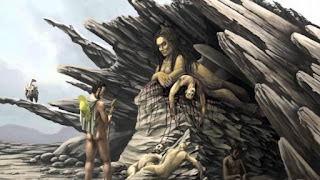
This week, I saw the opportunity to take the D&D theme I have been building into an area without the usual battle, but maintaining the conflict.  This was with the Riddles at the Lake reading in the Mahabhrata.  Riddles are a classic DM tool to provide a new challenges to players, so I was thinking that instead of the brothers, the Quintet of Capriciousness could undertake this challenge, with an opportunity for a new character to shine under this challenge, along with some more character development for the one's who have not really been mentioned.  This setting change will require a slight change of riddles, to make it more D&D appropriate.  Other than this I do not have much in the way of takeaways from the reading, other than potentially replacing Darma with Dee-Yem, which could also make him seem more villian-y.   Oedipus and the Sphinx, from  Here be Dragons This image was inspired by the most famous of puzzles of all time, drawn ...

Week 6 Story, A Tale of Fire

Image
Rejoicing after their long adventures, the five Pandava brothers threw a feast for their companions, the Quintet of Capriciousness, made up of Adalard, Uther, Luna, Dro'vahkin, and Ush-Goth.  Dee-Yem, god above all, decided that he was done looking out for the party this week, and sent the god Krishna instead as his ambassador to their rejoicing.  Rejoice with them he did, and as the fest went on he grew more confused as to why Dee-Yem was always complaining about the adventurer, because they were exceptionally fun to hang out with.  As they were eating and drinking, a cleric in tattered garments approached the revelers and asked for food.  With his deep insight, Uther recognized this man as more than a cleric, in fact, it was Agni, god of fire.  The brothers rushed to his side, asking what could be done to help him.  Agni explained that he had been weakened due to staying in his mortal form to long, and there was but one way to get his strength back. ...

Week 6 Reading, Mahabharata Part B

Image
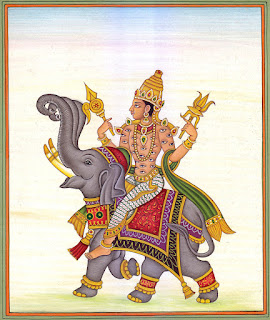
The story I focused on for potential storytelling exercise this week was the Burning of the Forest as told by John Mandeville Macfie.  I liked this story because the opening, with the feasts, drinking, and games, presented a celebratory down time not really seen in any of the stories thus far.  This offers an opportunity to explore a new side of writing where it can focus on storytelling and fun rather than just war.  Also, the idea of a god consuming so much he weakened himself and needs the help of heroes to fix his situation is humorous, and something to work with for the Mythological DM portfolio.  This quest, and the way the characters agree to help, provided they get divine weapons, is the perfect opportunity to show some peacetime D&D situations.  Plus, the battle with Indra at the end of the story maintains the combat presence, providing an epic conclusion to the relatively short adventure.  Indra, King of Storms, from  Pinterest Bi...

Week 6 Reading, PDE Mahabharata part A

Image
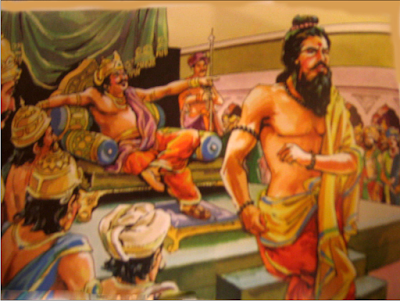
This week, the story that inspired me during reading was Drona' revenge.  The imagery of the battle, the description of the noises, the sights, give me something to work with in my own writing.  A heroid story centered on Drupada would be a great story, due to his heroic nature in the battle, as well as his resolve to quest for Brahmin power with which to defeat Drona.  This would give me a story of Drupada's quest, which I could not find anything in the reading to explain his actions further.  I will have to discuss if expanding a story rather than re-writing it is an acceptable storytelling assignment, and will go forward on that count accordingly.  Honestly, most of the notes I took away from this story were similar to my previous ones, and my goal is just to avoid making all my stories sound the same, while staying in a similar setting. Drupada insults Drona, from  Romapada Bibliography: Indian Myth and Legend, Donald Mackenzie,  Source ...

Week 5 Story: D&D Rama's Quest

Image
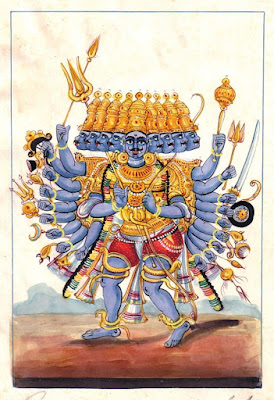
As the band of three adventurers, Rama the Ranger, Lakshmana the Fighter, and Sita the cleric pressed on through the forest, continuing on their quest, to where and what end only the god Dee-yem knew.  Their previous conquest, slaying the giant army, had angered a powerful giant named Ravana, who was a formidable opponent, with 10 heads and 20 arms, easily a challenge rating 20 opponent for a level 13 party.  To add to his power, he also was a formidable spellcaster, and casting illusion, turned a Rakshasa into a golden deer, and himself into an old priest.  The golden deer presented himself in front of the party, and the adventurers, certain this was Dee-yem's way of leading them to some magical items, sent Rama after it.  After a chase, he shot the deer, and the Rakshasa's dying breath was to call out, in Rama's voice, for the rest of the party.  Fearing the consequences of splitting the party, they rushed to the door, where an old priest was there, asking for...

Reading Notes Week 5 Part B: Rama's Quest

Image
In part 2 of this weeks reading, I mainly focused on the retelling of the story that I myself wrote about last week.  I was thinking about writing this story again, because I want to challenge myself to find a way to rewrite this story without repeating myself.  I found the different elements in this story, such as it taking place in a cave instead of a palace, a magician creating the head instead of Ravana, someone taking pity on Sita rather than her figuring our the illusion.  Furthermore, I could write the story more about the battle this time, the trees being torn up by the roots to use as clubs.  As previously noted, the "godlike" armor Wilson describes also could be a detail used to bring forth a D&D story.  The "deaths" of the heroes is another detail that would be amazing to write about.  Rama Slays Ravana, from  Ritsin Bibliography: Rama's Quest, Wilson,  Source