Posts

Showing posts with the label Reading

Week 12 Reading B, Bhagavad Vita

Image
In this story, Divine and Demonic Qualities, Krishna explains to Arjuna the good and bad features, actions, and behaviors of people, explaining what is divine and what is demonic.  As expected, honor, truthfulness, nobility, nonviolence, forgiveness are the attributes of a divine spirit or person, and pride, anger, ignorance, and hypocrisy are demonic qualities.  These are unsurprising qualities, but do give an insight into the author's religious beliefs.  Furthermore, the good are expected to be destined for nirvana, and the evil for servitude, and everyone is described to be either divine or demonic, destined for one or the other.  It is talked about how demonic people only understand the world as want, and act only for themselves, thereby causing the destruction of the world.  This was an interesting, enlightening chapter, and gave me deep insight into another worldview. Lord Krishna, from  pixabay Bibliography: The Bhagavad Vita, translated by P...

Week 12 Reading A: The Bhagavad Vita

Image
In this epic, the story that caught me for part A of the reading was Chapter 2, Transcendental Knowledge.  It was interesting to me to see Arjuna struggle with the thoughts of fighting and potentially killing Bheeshma and Drona.  He says this because he wants to avoid this sin of slaying his kin in battle, professing to rather be slain defenseless instead. To this, Krishna gives an extremely long speech to Arjuna, talking about Atma (consciousness/self), and fate, and tells him how all things are fated to be, and death and life hold very little meaning because all is just a part of Atma.  This is the Transcendental Knowledge the chapter was talking about, and a very interesting persepective into the beliefs of the writers of this epic.  Statue of Arjuna, from  wikimedia Bibliography: The Bhagavad Vita, translated by Prasad, Ramanand,  Source

Week 11 Reading B: The End of the World

Image
This week, the story that really caught my attention was The End of the World.  Part of the reason I liked this story was I remembered it from earlier in the semester, and remember the good stories that several people got out of it.  I think this would be a chance to have some lighter humor in the D&D universe I have been writing in, and provide an opportunity to poke some fun at Ush-Goth the Barbarian.  Barbarians are not known for their intelligence, and so it is completely plausible that Ush-Goth would see some great phenomenon and think it was the end of the world.  It also would be funny to have the chain of blame go on throughout the party, especially to see how talkative characters like Adalard would try to talk their way out of it.  Overall, I see in my mind the story as it would shape up in writing, and now have to decide which of my reading stories I use this week. Kneeling Barbarian, from  wikimedia Bibliography: Twenty Jataka Tales,...

Week 11 Reading A: The Tortoise and the Geese

Image
This week, my favorite reading this week was The Tortoise and the Geese, due to the lesson about the value of silence.  I think it would work perfect for my D&D story because it could keep the same message on the value of silence while being made into a humorous tale.  My thoughts are that it will be a lesson to the rogue, because rogues are famous for talking themselves into and out of trouble.  As far as consequences, letting go of a stick seems out of the ordinary, but there definitely will be other fantasy situations which are appropriate for the setting.  Overall I am very excited for writing this story, because it will provide a different sort of story then I have been doing. Rogue Assassin, from  Flickr Bibliography The Tortoise and the Geese , Twenty Jataka Tales, Noor Inayat

Week 10 Read Part B: Jataka tales

Image
For the second part of the reading, my favorite story was Granny's Blackie.  I thought that as a story for children it was excellent, with the main lesson being that at some point in our lives we must grow up and take responsibility.  Blackie, the elephant, seeing Granny is getting exhausted from all her work to support them, takes it upon himself to earn the money for Granny and get a job.  The secondary message in this story comes when Blackie completes the job and is offered less pay then promised, and he holds firm until the man pays him his just wages.  He also resists all the temptations of fun he used to give into and stays steadfast in his resolve to be responsible, and as the story states, continues on doing the same in the future.  This story, while probably not what I will write a story about this week, nevertheless was my favorite story out of all the part B jatakas.  Black Elephant, from  pexels Bibliography: Granny's Blackie , Ja...

Week 10 Reading Part A: Baldwin Project Jataka Tales

Image
This week the story that caught my attention most of all the ones we read was How the Turtle Saved His Own Life .  This story was fascinating to me because it reminded me of the Brer Rabbit stories I read as a child, which were some of my favorites.  The Turtle using reverse psychology in order to trick his captors into giving him the best available "death" which in fact freed him always made me laugh, and I want to be able to modernize this laugh in my own writing this week.  To do so, the first thing would be to expand on this dialogue, make it longer, and make the turtle more sarcastic and humorous, like Brer Rabbit.  This will allow me to put some more modern commentary in the story.  Another potential twist I could add would be to put the story in a tech world, something to do with robots or the like, to give it a new setting I don't believe the story has been done in yet.  This could be done for most of the other stories this week, but because of the ...

Week 9 Reading: Krishna Dharma's Mahbarahta Part B

Image
for this reading, I focused on the story of the Pandava's being sent away, because it would be a break from the previous stories of battle or feasting I have written, and focus on another important portion of D&D lore, the intrigue.  It would give me an opportunity to create a villain like Dhuryodhana who does not act openly for combat, but instead behind the scenes to eliminate our hero.  It also would allow me to highlight typical D&D skills like insight, perception, languages, etc, in order to get the heroes out of the predicament they will find themselves in.  Burning City from  pinterest Bibliography: Krishna Dharma, Mahabharata,  The Pandava's sent away

Week 9 Reading: Krishna Dharma's Mahabhartha Part A

Image
This week, I focused on  the story about The Martial Exhibition.  I was drawn to this story because of the descriptions of the training, especially Arjuna, because his exploits and skill are definitely the foundation of a story.  The story itsef and the granting of the divine weapon fit in this semester's D&D theme, and the brothers themselves can become the actual adventuring party.  Arjuna will translate well to Luna the Ranger, because bow prowess is the stereotypical ranger expertise.  The jealousy itself can be expanded on, and the final duel could become a blow by blow fantasy narrative, hopefully sometihng done as skilfully as Nate's project story from last week. Ranger, from  pinterest Bibliography: Krishna Dharma,  The Martial Exhibition

Week 7 Reading Part D: Mahabharata

Image
In Part D of the reading, the story that attracted me most was Ashwatthaman's Jewel.   The reason for this was it would give me something in the D&D stories that I have been missing, something crucial to a good D&D campaign.  This missing element is a Big Bad Evil Guy (BBEG), and while Dee-yem is an antagonist, he is not actively evil or against the quintet, and this is the role Ashwatthaman can fill.  I went beyond the reading to find out more about him, because the idea he was almost immortal due to the gem in his head, as well as the continued legends until today, allow for a lot of artistic liberty with the character.  The story itself is somewhat vague on the hunt to retrieve the gem from his head, so that angle is something I would like to bring out more, because it would be an adventure/encouter for the hero's, direct conflict other than running from an overwhelming horde. Ashwatthaman, from  detechter Bibliography: Indian Myth and Legen...

Week 7 Reading Part C: Mahabharata

Image
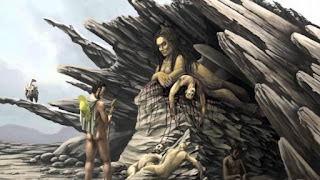
This week, I saw the opportunity to take the D&D theme I have been building into an area without the usual battle, but maintaining the conflict.  This was with the Riddles at the Lake reading in the Mahabhrata.  Riddles are a classic DM tool to provide a new challenges to players, so I was thinking that instead of the brothers, the Quintet of Capriciousness could undertake this challenge, with an opportunity for a new character to shine under this challenge, along with some more character development for the one's who have not really been mentioned.  This setting change will require a slight change of riddles, to make it more D&D appropriate.  Other than this I do not have much in the way of takeaways from the reading, other than potentially replacing Darma with Dee-Yem, which could also make him seem more villian-y.   Oedipus and the Sphinx, from  Here be Dragons This image was inspired by the most famous of puzzles of all time, drawn ...

Week 6 Reading, Mahabharata Part B

Image
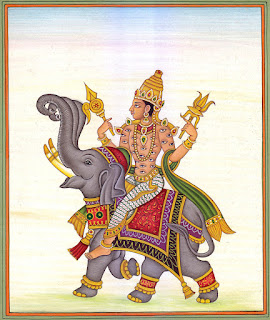
The story I focused on for potential storytelling exercise this week was the Burning of the Forest as told by John Mandeville Macfie.  I liked this story because the opening, with the feasts, drinking, and games, presented a celebratory down time not really seen in any of the stories thus far.  This offers an opportunity to explore a new side of writing where it can focus on storytelling and fun rather than just war.  Also, the idea of a god consuming so much he weakened himself and needs the help of heroes to fix his situation is humorous, and something to work with for the Mythological DM portfolio.  This quest, and the way the characters agree to help, provided they get divine weapons, is the perfect opportunity to show some peacetime D&D situations.  Plus, the battle with Indra at the end of the story maintains the combat presence, providing an epic conclusion to the relatively short adventure.  Indra, King of Storms, from  Pinterest Bi...

Week 6 Reading, PDE Mahabharata part A

Image
This week, the story that inspired me during reading was Drona' revenge.  The imagery of the battle, the description of the noises, the sights, give me something to work with in my own writing.  A heroid story centered on Drupada would be a great story, due to his heroic nature in the battle, as well as his resolve to quest for Brahmin power with which to defeat Drona.  This would give me a story of Drupada's quest, which I could not find anything in the reading to explain his actions further.  I will have to discuss if expanding a story rather than re-writing it is an acceptable storytelling assignment, and will go forward on that count accordingly.  Honestly, most of the notes I took away from this story were similar to my previous ones, and my goal is just to avoid making all my stories sound the same, while staying in a similar setting. Drupada insults Drona, from  Romapada Bibliography: Indian Myth and Legend, Donald Mackenzie,  Source ...

Reading Notes Week 5 Part B: Rama's Quest

Image
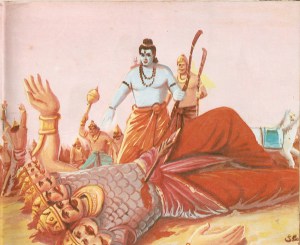
In part 2 of this weeks reading, I mainly focused on the retelling of the story that I myself wrote about last week.  I was thinking about writing this story again, because I want to challenge myself to find a way to rewrite this story without repeating myself.  I found the different elements in this story, such as it taking place in a cave instead of a palace, a magician creating the head instead of Ravana, someone taking pity on Sita rather than her figuring our the illusion.  Furthermore, I could write the story more about the battle this time, the trees being torn up by the roots to use as clubs.  As previously noted, the "godlike" armor Wilson describes also could be a detail used to bring forth a D&D story.  The "deaths" of the heroes is another detail that would be amazing to write about.  Rama Slays Ravana, from  Ritsin Bibliography: Rama's Quest, Wilson,  Source

Reading Notes Week 5 Part A, Rama's Quest

Image
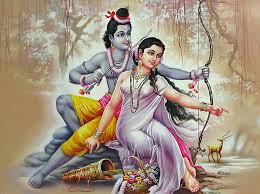
For my reading this week, I read Rama's Quest by Wilson.  The Ravana and Sita story I thought very interesting, because it could bring back another Dungeons and Dragon's story, due to its depiction of Rama, Sita, and Lakshmana as wanderers, Ravana as a giant, and the idea of kidnapping, magic, and rescues felt like the perfect tale.  Another interesting thing is that the focus on Ravana's thoughts in this story allow me to make a story potentially villain focused.  The 10 head and 20 arm description of Ravana also gives a great literary tool to play with, I have several ideas but nothing I am sure I want to use as of yet, and is mostly situational om whether I want a more epic or humorous story.  Rama with bow and Sita from  Flickr Bibliography: Rama's Quest, Wilson,  Source

Reading Notes, Ramayama Part D

Image
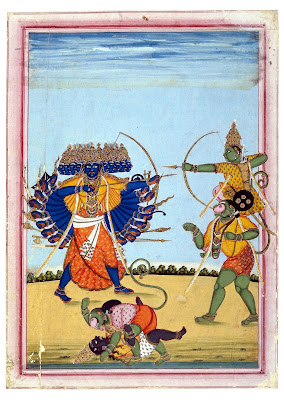
The story that inspired me for my storytelling exercise in this was the story Rama attacks.  The visuals in this story are amazing, the rain of blood, the fiery circle falling from the sun, etc.  This imagery provides a stunning canvas to paint my own tell, and attempt to make my own version even more epic.  The whole battle stories to tell with the siege and then the lies spread by Ravana give a psychological narrative as well.  The battle of psyches between Sita and Ravana gives another battle narrative, one that could become its own story.  I am not decided which of these two narrative I wold want to tell, but I do know all the groundwork that I need is there. Rama and Hanuman fighting Ravana, from  Wikimedia Bibliography: Myths of Hindus and Buddhists, Sister Nivedita,  Source

Reading Notes, Ramayama Part C

Image
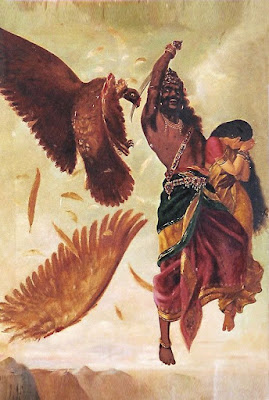
This week, the story that caught my attention for doing my weekly storytelling assignment was the story of Sampati and Jatayu. Ravana Cutting off Jatayu's Wing, from  Temple Purohit This story stood out due to the complex emotional themes of the brothers relationship, and the folly and pride of their race that led to Jatayu's death.  The image above is a different story, but one that I did further reading on and might consider finding a way to work into this tale in this week's storytelling.  I loved how the race itself could be given a deeper meaning or purpose, adding another dimension to the story.  Sampati's sacrifice could also be given a longer telling, and once again, the potential of fusing this story with the other version I read is tempting, having the brothers encounter Ravana on their adventure.  Overall, between this weeks reading and extra research, I feel confident in the amount of material at hand to work with.   Bibliograp...

Reading Notes: PDE Ramayama, Part B

Image
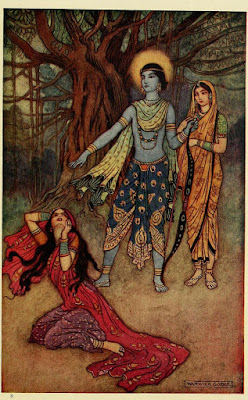
For Part B of the reading, I once again focused on finding a narrative I would want to tell, leading me to the stories of Shurpanakha and Rama, and Lakshmana.  The few characters in these stories, along with the clearly defined relationships, provide a rigid framework, something to give solid bounds to my own story, while allowing me limitless personalization within this framework.  I think the clear motivations of each character particularly attracted me, due to being able to now write a story to provide more insight into what their motivations were, rather than trying to create my own motivation.  Rama spurns Shurpanakha, from  Wikimedia This image I found the most striking of the ones I have seen, just because the pure expression of rage on Shurpanakha's face could be a whole short story in and of itself.  They say a picture is worth a thousand words, and so I believe this picture is the best way to demonstrate what I am thinking for my story....

Reading Notes: PDE Ramayana, Part A

Image
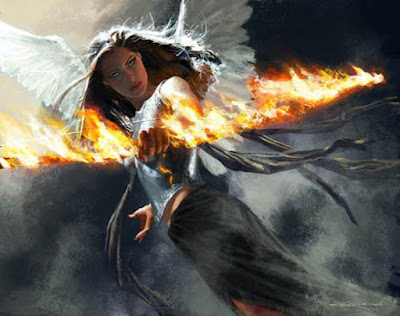
For me, the biggest takeaway from all my reading was the reconciliation of all the different authors of the different stories from the public domain Ramayana.  Looking at the slight changes in style and storytelling showed me the variety of ways I can treat my own storytelling assignment. The stories I spent the most time on this week because they held a similar antagonist to my week 2 story were Vishvamitra and Thataka.  The rakshasas as the antagonist will put me in familiar writing territory, as well as the descriptions of heroic and magical battles.  Another thing that drew my attention was the mention of celestial weapons, this I believe a small detail that I can expand upon in my own storytelling assignment this week. The fire weapon, particularly with Rama traditionally being seen as wielding a bow, led me to this sort of concept for what his weapon should be Angel with fire bow, from  QueenAnneBoleyn The ethereal, not quite completely physical natu...

Reading Notes: Jataka Stories

Image
In reading the Jakata Stories for this week, my first impression was the similarity to Aesop's fables, morality tales imparting wisdom in an easily digestible manner.  Their brevity and clarity, combined with the fact they are simple enough to be told to children with themes important for adults as well make them a great vehicle to teach valuable lessons.  In writing my own storybook, my takeaway it to ensure to carefully write, in order to not over complicate the message I am trying to tell.  Instead, the writing needs to be short, simple, and straightforward, avoiding complexity in favor of approach-ability. The story in particular that caught my attention was Goblin City, due to the theme inside being something that transcends fables.  The unsolvable situation requiring deus ex machina  and a leap of faith to solve, this story provides multiple lessons of wariness and belief at the same time.  The reason this story struck so close to home was all the c...

Reading Options for Epics of India

Image
Looking through the reading options for the course, the Mahahbarata really caught my eye as something I was extremely interested to dive into the readings.  The theme of an inter-familial feud, with the divine influence on both sides of combatants, is a thrilling narrative that I find familiar, due to my interest in Teutonic mythology.  It was mainly in this story I did my deepest research into reading options, due to my interest, as well as doing research into the sources themselves.  While I did look over the Ramayana readings as well, the three selections shown here were my three picks for most intriguing.  Balabhadra fighting Jarashanda, from  Wikimedia Commons First, the public domain edition of the  Mahabharata  drew my attention, mainly due to its use of more antiquated language, giving it a feel of originality.  Furthermore, the fact that there are different authors of each work I feel will give me a better overall picture of this ...